
Story Hour
Nicker Learns About Cotton Candy
Written by Gene B. Williams
|
Click here for the archive page with a list of previous stories. Please remember that all materials on this website are copyrighted. No reproduction without express permission. |
Gene B. Williams |
 |
| This is a copy of the paper wrapper that covered the box of cotton candy at the 1904 World's Fair. |
Do you like cotton candy? I sure do!
Last month was Danny’s and Nicker’s birthday. As usual we had all kinds of things with peanuts and peanut butter. (Click here to read that story.) The first time people could have peanut butter was at the World’s Fair in 1904. If you had been there, you could have also had the first cotton candy. It was sold in boxes with a paper wrapper that said, “Fairy Floss Candy.”
The real history goes back farther. Nobody knows how far back. When there were knights, sugar was heated until it would melt. A fork would be used to pull it very fast, and sometimes spin it. This gave strings of sugar. Later, these were used to make pieces of art. Artists would use the strings to make animals, eggs even castles. Of course, this was very expensive. Only the rich could enjoy them.
At the 1893 World’s Fair in Chicago, Tootsie Roll of Canada had something they called “fluffy stuff.” It was similar to cotton candy, but not quite the same. In 1897, two candy makers from Nashville named William Morrison and John Wharton invented a machine that would melt the sugar, then spin it so it went through tiny holes. As you already know, they called it “fairy floss.”
It’s still called fairy floss in Australia. In England it’s called candy floss. The French call it “grandfather’s beard,” and in India it’s called “old lady’s hair.” The name “cotton candy” came about when a dentist from New Orleans would give it to his patients as a treat for being good.
At first it was put into boxes. It cost 25c at the World’s Fair. At today’s prices, that would be about $6. Later, it was more commonly sold on a paper cone. That’s how my grandfather, and later my father, sold it. A rectangle of paper was twisted into a cone, and the end bent to hold it together. The cone was turned around and around in the big tub where the cotton candy was collecting.
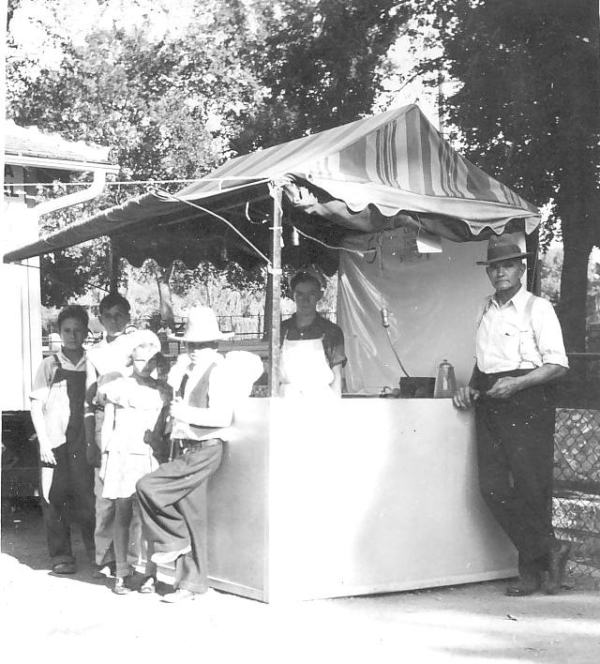 |
| My grandfather was selling cotton candy in the 1920s. |
 |
| Later my parents took over that business. This is my mother and father. |
It takes just a spoonful of sugar to make a pretty big cone. Most of it is air. I had an uncle who used to say that Dad was selling “sweet air.” That’s pretty much the truth. The actual amount of sugar needed to make a full cone is less than you’d get from a can of soda pop.
Flavorings and colors can also be added. In “the olden days,” it was common to put in just a little vanilla. That wasn’t so much for the taste. It was to make a wonderful aroma. Pink has always been the most popular color, but it can really be anything you want. These days, it’s sold mostly in pre-packaged bags. The machine that makes it is back in a factory somewhere. Maybe you’ll get lucky, though, and go to a fair, carnival or circus where someone is actually making it. Mmmmmmm!
Whatever you call it, this spun sugar is delicious – and FUN! It doesn’t just melt in your mouth (as they say), it melts all over everything! Nicker found this out the hard way. Danny was eating some blue cotton candy. Nicker was hiding in a bush nearby and saw a cone of yellow cotton candy. Nicker thought it was peanut flavored. In a flash, Nicker was out of the bush, had the cone in his mouth and was back in the bush again.
What a mess. There was cotton candy on the bush. There was cotton candy on the grass. There was cotton candy all over Nicker’s face. Also all over his face was a big messy, smile.
He looked up at Danny and said, “It’s not peanut, but … can I have more?”
I bet you would ask the same. Wouldn’t you?
Like this story?
Click here to see previous stories!
