
Story Hour
Repeet Gets Sick
Written by Gene B. Williams
|
Click here for the archive page with a list of previous stories. Please remember that all materials on this website are copyrighted. No reproduction without express permission. |
Echoes From the Lunch Wagon
Tis dogs’ delight to bark and bite
Thus does the adage run
But I delight to bite the dog
When placed inside a bun
Yale Record, 1894-95
Have you ever had a hot dog? No, that doesn’t mean a pet left out in the sun.
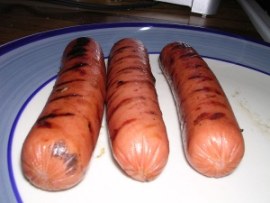
Nobody knows where the idea came from. The same is true of most of the things we eat, though. Then these things change over time. People ate bread. People ate meat. Meat can be cut and cooked in many ways. Some cuts aren’t “steaks.” It gets chopped up fine, or is “ground.” That can be used all sorts of ways. Just one way is to stuff it into a “skin.” That held the meat together. It could then be boiled, broiled, grilled, roasted, fried, put on a stick over a fire …
 |
 |
A Little Hot Dog History
In 850 BC (that’s almost 3000 years ago) a man named Homer wrote The Odyssey. A form of hot dog is mentioned in that book.
At least in America, the hot dog comes mostly from the German versions.
 |
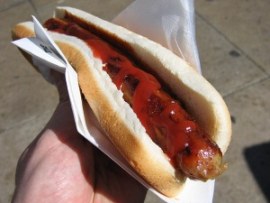 |
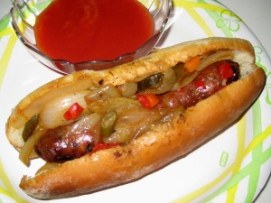
On the left is a sausage in a bun, covered with all kinds of goodies. On the right is a more traditional hot dog of today, fresh from the grill and ready for toppings – and eating. |
Another word for hot dog is frankfurter. This comes from the city of Frankfurt in Germany. More than 800 years ago, sausages in buns – hot dogs – were handed out to the people when someone was coronated. (That means named to be a king, queen or something.) You might still hear hot dogs called “franks.” This is where it comes from. Frankfurt.
In the 1600s, Johann Georgehehner made and sold them. He called them “dachshunds” (docks-hoonts) which means “little dogs.” Later, 1901, a cartoonist named Tad Dorgan didn’t know how to spell dachshund so he used the idea of them being called dogs, and since they were sold hot … we call them hot dogs. (At least that’s what ONE story says.)
“Wiener” came to us from Vienna. In German, the “W” is pronounced like a “V” in English – at least sometimes. Sometimes it’s the other way around. A kind of sausage made here called “Wien,” or “Vien.” “Vienna sausage” is still like little hot dogs. The bigger ones are called “Vienners,” or “wieners.”
Here’s another word for you to learn. Wurst. It means sausage. Still another word is brat. It’s pronounced brawt. It means beef. So a bratwurst is a beef sausage. It’s not really a hot dog, but since we’re learning words I thought you’d like to know.)
In about 1870, not long after the end of the Civil War, Charles Feltman began to sell sausages on buns at Coney Island. From that, hot dogs are also sometimes called “coneys.” Feltman would push a cart along the beach and sell the hot dogs for 10c. This quickly expanded. When he died in 1910, he was worth $22 MILLION!
Right about the same time, Antoine Fuectwanger was selling sausages on the streets of St. Louis. At first they came with gloves so the people could eat without getting their hands greasy, but people wouldn’t return the gloves. That got to be very expensive. They began to serve the hot sausages with buns. By 1893 at the World’s Fair, the gloves kept disappearing, and the buns took over.
Meanwhile, the same idea of a sausage on a bun got into other areas. In 1889, hot dogs on buns were very popular at baseball games. They were fast, easy, tasty – and if careful, not TOO messy. Harry Stevens was soon called, “King of Sports Concessions,” with a big part of that being the sale of hot dogs.
By 1916, a man named Nathan Handwerker decided to try the business. Where others were selling their hot dogs for a dime, he sold his for a nickel. It was at a time when people began to wonder just what was IN those hot dogs. This was nothing new. About 60 years earlier a rumor came out that they were made from dog meat. That’s another story about how we get the name hot DOG. Handwerker went to werk – I mean work – to show that his hot dogs were healthy, and from quality meats (not dogs) – so healthy that he showed men in doctors’ gowns eating his hot dogs.
Many Kinds of Hot Dogs
 |
 |
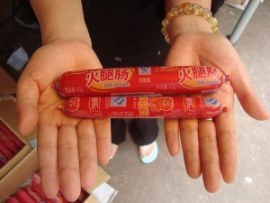
These are hot dogs made in China. |
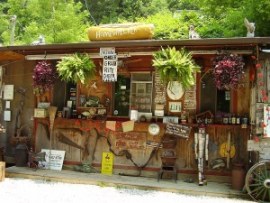
This hot dog stand is in the state of Virginia. |
Hot dogs are no longer just sausage on a bun. They’re certainly not just an American thing. They are found all over the world. They might be short, long, fat, or skinny. It might be in a bun or roll, or wrapped in a pancake or biscuit, or covered with a cornmeal mix and deep fried. You can have it plain, with ketchup, mustard, sauerkraut, onion, relish … and on and on and on!
Today, hot dogs are still made from various meat by-products. Leftovers. Beef, pork, chicken and turkey are the most common. It might be just one kind of meat, or might be a blend. Some have no meat at all (for people who don’t eat meat). Flavorings are added, such as salt, pepper, garlic and so on. Cereals, including soy flour, can be used as a filler and binder. It’s all ground into almost a paste.
In “the old days” this was pushed into a skin. Some people didn’t like the snap, so “skinless” hot dogs were developed. Today, most are this kind. It came about in Chicago in 1925. Some still prefer the “natural casing” because it holds in the juices. Most seem to prefer the softer casing that almost seems to not be there.
These days, most sausage is raw (unless it is marked pre-cooked). Most hot dogs are pre-cooked. That doesn’t mean you should eat them unheated. There can still be bacteria in there.
 |
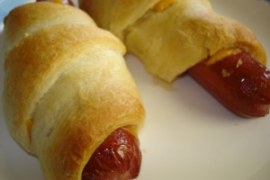 |
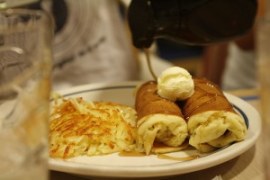
These are two kinds of “pig in a blanket,” and aren’t the only ways it is done. On the left is the kind you would get at an IHOP. On the right, crescent rolls are used. |
So … now you know all about hot dogs. I think you already know how to eat them – right?
|
Like this story? |
