
Story Hour
May Bee
Written by Gene B. Williams
|
Click here for the archive page with a list of previous stories. Please remember that all materials on this website are copyrighted. No reproduction without express permission. |
 |
 |
In one old legend, all the creatures came into being then got into a line where each could ask the creator for something special. The lion asked for strength. The cheetah ask for speed. The lowly bee said that all the good things had already been given, and now the others would pick on her. She wanted some way to at least protect herself. The creator gave her a sting. It didn’t take her long to learn how to use it, and soon there was another line. Bee had become a bully. She would sting the other animals, not to defend but because it was fun. The other animals were getting tired of this and begged the creator to have this gift taken away from the bee.
The bee was called in. “If you take away my sting,” she complained, “I will have nothing at all.”
The creator said, “You can keep your sting, but from now on, when you sting, you will die.”
I don’t remember where I first heard this legend. The bee can sting, but there are barbs on the stinger. When it stings, the barbs get caught in the skin of the animal being stung. As the bee flies away, the stinger is stuck. The bee will leave behind most of its insides. (Yuck!) There will be the stinger, the poison sacs and “muscles” that “pump” the poison, and pretty much everything else.
The bee will die.
It can sting only once.
This is important to know for several reasons.
For yourself, when a bee stings you might want to swat or rub. Don’t! Even if the bee is gone, it has left behind a poison sac. If you look closely, you can actually see it still pumping that poison through the stinger. If you push on it, all you are doing is helping it. Far better is to scrape. That will break the poison sac from the stinger.
Everything bees do is about the hive. The colony. Bee City.They sting to protect it (which includes while they are getting nectar for the hive). That this sting will kill the bee doesn’t matter to them. Only the colony matters. Everything to them is about the hive.
As you read this – the life of a bee might sound confusing, but it’s really not.
 |
 |
At the center of the hive is a queen bee. Her job is to lay eggs. That’s all she does, and she does it well. She can lay up to 2500 eggs per day. She has to. Bee City – the hive – often has 30,000 to 60,000 members (but just one queen, usually). A lot of these bees live just one month, so the queen has to keep laying eggs to make new bees or soon Bee City will be a starving ghost town.
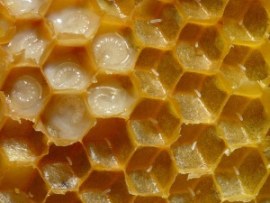
Bees eat their honey. It then comes out as bee’s wax. This happens in way a little like how you sweat. It comes out of glands, but with bees it doesn’t evaporate. It makes wax. The bees chew this and use it to build the combs. These combs are made up of hundreds, even thousands, of cells. Each cell has six sides (called a hexagon, if you like big words).
The queen bee uses these to lay one egg in each cell. Then “nurse bees” put in royal jelly. This is like a special kind of honey. When the eggs hatch the larva (like a little worm) feeds on this and grows to become a new bee. The young bee continues to be fed, but not with royal jelly. That would make the young bee into a queen bee. Nobody know exactly why this happens, but it does. That’s why it is called royal jelly
Some become drones. These are the boy bees. They have just one job. They mate with the queen to fertilize the eggs. (Then they are killed.)
Most become worker bees. All of them are female, but they can’t have babies. Only the queen bee can do that. All the others work – which is why they are called worker bees. They go out of the hive to gather nectar and pollen. They keep the hive at a steady temperature. They make the honey – and the bee’s wax. They build Bee City, and keep it going.
They work so hard that after about a month, their wings are worn out.
But the queen has been busy laying lots and lots of eggs to replace the worn out bees. (The queen will live 1 to 5 years.)
 |
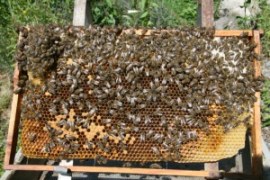 |
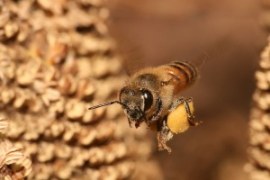
The worker bees fly from the hive to find flowers. On an average trip they will visit 100 different flowers. They do this 10-15 times each day. At the flowers, they collect nectar and pollen. As they go from flower to flower, the pollen is shared between the flowers. This makes it possible for the plants to grow. Many farmers love bees. Without the bees, the plants couldn’t grow. For example, if bees didn’t go from one orange blossom to another orange blossom … there would be no oranges. (And no orange blossom honey.)
The bee has two stomachs. One is like your own. It feeds the bee. The other is a nectar stomach. It stores the nectar that the bee is gathering. If the bee needs food to do its work, a little of the nectar goes from the nectar stomach to the eating stomach. The bee continues to visit flowers until the nectar stomach is full. By then, the bee is nearly twice its normal size and weight.
Now it flies back to the hive.
Imagine that you are a bee. You get up in the morning. You flap your arms really hard and go visit 100 different places. Then after you are twice your weight, you flap your arms even harder to come back home. You do this 15 times every day. Is it any wonder that your arms wear out?
But your work isn’t done.
Back in the hive things are still busy as a bee.
For one, there is dancing. It’s not really dancing, though. The bees move around each other. That’s how they tell each other where the best nectar can be found. That’s why you find so many bees in certain places. They’ve told each other about it.
In the hive, the nectar stomach is emptied. Now the empty bee can fly off to get more nectar. The nectar gets put into the cells of the comb. This is like putting bits of Kool-Aid into hundreds of little cups.
If you’ve ever been near a bee hive you know that it buzzes. It hums. Some of this is from the bees flying in an out. Most of it is because down inside, the bees are busy blowing. They’re not flying around, but they are wagging their wings. This keeps the temperature inside the hive at a steady temperature (about 95F). It also causes the water in the nectar to evaporate.
It is becoming honey!
Bees have to eat, too. From that comes the bee’s wax (remember?), and that gets put over the cells (remember?) of honey until it is needed.
BUSY AS A BEE It takes the nectar of about 2 million flowers to make a pound of honey. To do that, the bees fly about 55,000 miles to and from the flowers. It takes a dozen bees their entire life to make just one teaspoon of honey. And as the hive eats the honey, it takes about 8 pounds of honey to make a single pound of bee’s wax. Even a medium-sized “super” (the box hive with frames) can produce 35-40 pounds of honey. That means the bees ARE busy. To fill just a medium hive with honey, they get nectar from about 75 million flowers, and fly about 2 million miles to do it. |
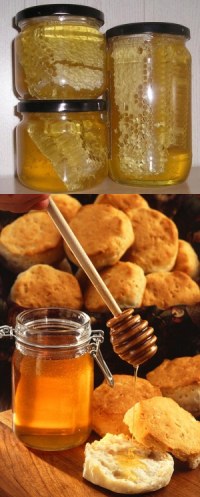
“Bee bread” is a mixture of honey or nectar and pollen. It is also called “ambrosia.” Some ancient stories say that eating it can make you live forever. |
Beekeeping has been around almost as long as people have been around.
You already know that bees make it possible for many plants to grow by spreading the pollen. Without bees, people wouldn’t have the food that these plants make. While the bees do this, they make honey. For thousands of years, honey has been used as food. In fact, it is the only food people eat regularly that is made by insects. From ancient times, it was treasured, even worshipped.
These days, honey is often “big business.” Let me tell you about a “small business” where I get my honey.
When he was young, a part of his family was involved in beekeeping. He learned a lot!
Bees sometimes swarm. This can be dangerous. Since he knew how to handle bees, he could be hired to safely remove a swarm. This was safe for the people, and also safe for the bees. He would gather the swarms without harming the bees, and then take them to places where they can live – and thrive in the hive.
Many farmers welcome bee hives, as long as they are controlled. The bees pollinate the crops.
Now he had a double business. He would safely collect swarms, then safely pollinate crops.
Of course, bees make honey. Now he had a third business. He could sell the delicious honey.
Most hives these days are in boxes rather than wild hives. Inside the boxes are panels that slide in and out. The bees build their honey combs in these. Usually a special panel is put between the honey combs and the brooding chamber where the new bees grow. There are holes in this screen big enough that the worker bees can go in and out. The holes are too small for the queen. That keeps her on one side, and the honey on the other.
The beekeeper wears a special suit to protect him or her. The supers are pulled out and taken to the honey house. The honey in the cells have been coated with bee’s wax. This is scraped off. Then the honey comb is put into a machine called an extractor. The frames get spun. The honey comes out and is collected. Usually, it is left alone. This allows things that aren’t honey to either sink to the bottom or float to the top. Then it goes through filters to be cleaned.
And there it is! HONEY! Ready to be put into bottles, and ready for you to eat.
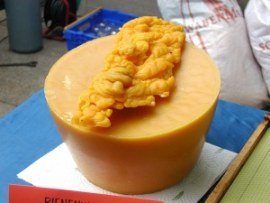
WAX CAPPINGS All those cells are capped with bee’s wax. This has to be scraped off to get at the honey, but it doesn’t get thrown away. Often, the wax caps are placed on a screen to drain off more honey. Warm water can then be used to melt the wax. (A solar heater can be used for this.) For thousands of years, people have used it many different ways. Artists used is as a modeling clay. It was used to seal and waterproof thing. (The toilet in your home might have a beeswax ring to seal it to the floor.) It is used in shoe and furniture polish. Another use is to recycle it. Beekeepers often put it out as a treat for their bees. They eat it, and also bring it back inside the hive to use it again. |
 |
 |
|
Like this story? |
