
Story Hour
Santa's Comet
Written by Gene B. Williams
|
Click here for the archive page with a list of previous stories. Please remember that all materials on this website are copyrighted. No reproduction without express permission. |
This story is for the September 2013 issue of Nicker Stories. It’s about a special comet. If you read this a year later, that comet will be gone. Still, there will be other comets.
SANTA’S COMET’S COMING TO TOWN
You’d better watch out
You’d better not cry
You’d better not pout
I’m telling you why
Santa’s Comet’s Coming to Town
At least, we HOPE so!!!
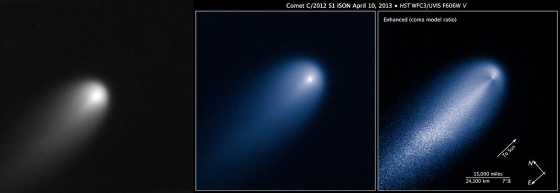
You see, right now no one really knows. September will be an important one for Santa’s Comet. So will October and November. That’s why it is in this issue. You have the chance to know about it, and to watch what happens. It could be “the comet of the century” and light up the sky brighter than a full moon. Or it could fizzle into an almost invisible nothing.
Its technical name is C2012 S1. It’s also called Comet Ison. You can look it up online with those names to learn the latest news. (Nicker News will also be giving updates.) WE call it Santa’s Comet! Why?
It’s a comet, and will be closest to Earth on Christmas. (Actually on December 26th.)
Santa also comes on Christmas. Santa has a reindeer named Comet. So, Santa’s Comet will be here on Christmas. So will … Santa’s Comet. And both will be here for Christmas.
Santa’s Comet’s Coming to Town.
This is what it is what it will do – the path it will take.
This month, September, it is flying faster and faster between Jupiter and Mars.
Next month, October, it will pass the orbit of Mars.
On Thanksgiving Day, it comes closest to the sun then does a loop and begins to head out of the solar system.
At Christmas (actually the day after – December 26) it comes closest to Earth.
In January, the Earth will pass through the dust it leaves behind.
Here’s the thing. It could become visible this month – or it might not. It is on the far side of the sun, behind it since June and invisible. In the middle of August, the path took it a little to the side of the sun. When that happened, and it could be seen again, it wasn’t nearly as bright as expected.
Will you be able to see it in September? Maybe. Maybe not.
Will you be able to see it in October? Maybe. Maybe not.
Will it hold together? Maybe. Maybe not.
No matter what, Santa’s Comet IS coming. There could be TWO of them – one with fur and antlers and a tail – the other a huge snowball, also with a tail.
We will know much more this month (September 2013), still more next month (October 2013) and so on. And YOU can watch it all happen! Hopefully, it will put on a great show that you will remember for the rest of your life.
Or maybe not. But, at least YOU know what is going on up there!
WATCH IT COME
Write this down. Better yet, bookmark it. Then go visit. And visit it again tomorrow, and next week, and the week after. (Don’t forget to visit their Home Page. It’s WONDERFUL!)
http://www.cometison2013.co.uk/perihelion-and-distance/
They have counters that change as you watch. You can see Santa’s Comet speed up. When it closest to the sun, it will be traveling at about 450,000 miles per hour!!! You can watch it going faster and faster. And you can watch it coming closer and closer.
Remember – don’t visit this website just once. Go back and see it again.
WHERE DID IT COME FROM?
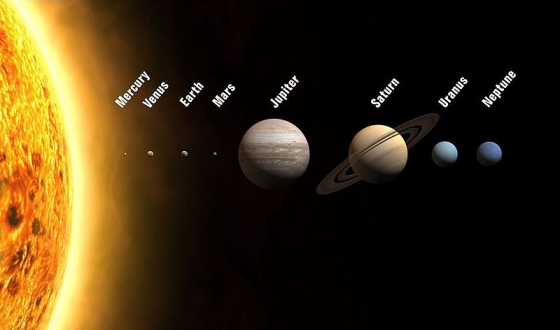
The center of our solar system is the sun. In orbit are eight planets (Pluto is no longer considered a planet) and other things like a swarm of meteors between Mars and Jupiter. Way out there, beyond Pluto, is something called the Oort Cloud. It’s very cold out there. Even gases like methane will freeze solid.
Do you know what dew is? Or what makes a rain cloud? Water vapor – a gas, not a liquid – cools and comes together. To do that, it needs someTHING, even a tiny piece of dust, or a blade of grass. Way out there in the Oort Cloud, there is dust and pebbles. The gases condense on them and then freeze. You end up with something a little like a “dirty snowball.”
Before we go on, between Mars and Jupiter is the asteroid belt. It’s cold there, too, but asteroids are more like big pieces of solid rock. When a piece of rock comes into our atmosphere, it begins to burn from the friction. Sometimes it leaves a tail of fire. In space, an asteroid doesn’t have a tail. It’s a piece of rock, not a big snowball. It only gets a tail when heat from going into our atmosphere burns it. It doesn’t have a tail out in space. A comet, however, can have a tail WAY off in space where there is no air at all.
With a comet, as it approaches the sun it gets warmer. In fact, it gets very hot. The gases that make it begin to evaporate. This makes it seem to glow. It’s called a coma (ko-mah). Think of it as the head of the comet. Then gases get blown off by the solar wind. That makes the tail.
By the way, a lot of people think that this shows the direction of the comet. It doesn’t. It shows where the sun is. That’s what makes the tail. When the comet gets to the other side of the sun, it still has a tail but is then flying INTO that tail.
Now – what about Santa’s Comet?
In 2012, Vitali Nevski, part of a group called ISON (the International Scientific Optical Network) spotted a comet. It now has the name C/2012-S1 (ISON) – or more simply Comet ISON. (The “C” means it is non-periodic, which means this is its only trip.)
If you have a telescope or binoculars, you might be able to see it now. It comes closest to the sun on November 28. By then it should be easily seen. It won’t be until December 26 – the day after Christmas – it comes closest to Earth.
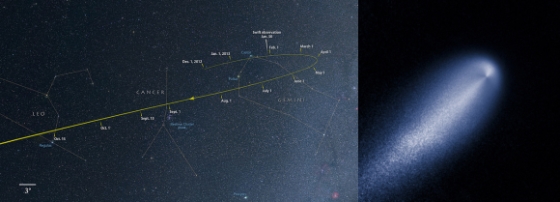
It comes closest to Earth on December 26, which will be about 40 million miles. The Earth won’t catch up to its actual path until January 14 and 15 of next year (2014). It will be long gone, but the Earth will pass through what the comet’s tail leaves behind. That’s when something else happens – or what might happen. We’ll pass through the rocks and dust and water. If there is enough of it, and the pieces are big enough, it could make the sky sparkle. Another possibility is something called a night cloud.
A LITTLE MORE ABOUT COMETS
Can you imagine being a caveman and seeing a comet up in the night’s sky? It would likely scare you. Comets have scared people even fairly recently. For a very long time, they were thought to be bad omens – bad luck. Many people thought that seeing a comet meant that the king would die soon.
The ancient scientist, Aristotle, called them "stars with hair." Today we use the Latin word for “long hair.” That word is … comet.
Those that can be seen easily are called “great comets.” Those show up every few decades. Most comets are never seen, except sometimes by scientists with big telescopes.
Those comets that come through the solar system on some kind of basis (they come back) are called “periodic.” Those that don’t, like Santa’s Comet, are non-periodic” or “irregular.”
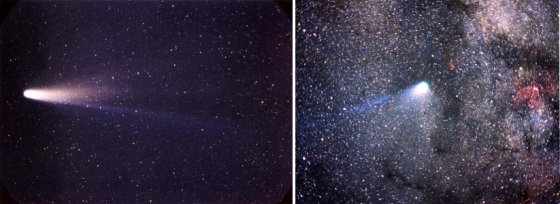
Probably the most famous comet is Halley’s Comet. It makes a pass by Earth every 75 years or so. It make an appearance in 1910. People who didn’t know better tried to scare other people who didn’t know better. The tail was going to poison the air and kill everyone. Of course, that didn’t happen. In fact, it came back for another visit in 1986. Many of you will still be around to see it in 2061.
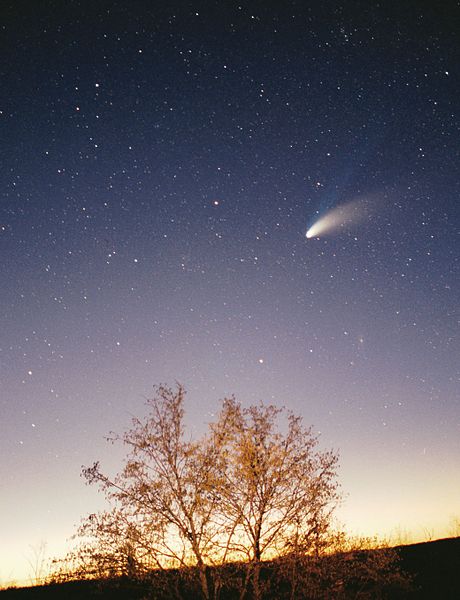
The Hale–Bopp Comet was discovered on July 23, 1995. It became visible for 18 months, longer than any comet before it. Were you old enough to see it? It is a “long period” comet, though. You’ll have to be very patient if you want to see it again. It won’t return unto the year 4385.
ONE LAST COMET – I mean Comment
This has already been said. Santa’s Comet is a COMET! It’s not an invading fleet of alien mother ships.It’s a COMET. There’s nothing hiding in the tail except … the tail. It’s a COMET. It’s not a big bad planet that will crash into Earth. It’s a COMET! The closest it will come is 40 million miles. That’s nearly 200 times as far away as the moon. If you hear stories to scare you, now YOU know better. Don’t let anyone scare you. Instead, have some fun with it. And learn.
Did you like this story? If so, please send us a note to tell us. Then tell your friends to come visit Nicker Stories.
|
Like this story? |
