
Story Hour
St. Patrick's Day
Written by Gene B. Williams
|
Click here for the archive page with a list of previous stories. Please remember that all materials on this website are copyrighted. No reproduction without express permission. |
This issue a lot of history in it. Especially with younger readers, it’s likely that the parents (or whoever) may have to get more involved. But, that’s the whole idea of Nicker Stories, isn’t it? It doesn’t matter if you are Irish, or Catholic. You can still learn, and have some fun.
This is one of the biggest holidays in March. It is to celebrate St. Patrick, the “patron saint of Ireland.” St. Patrick’s Day is March 17. It is a religious holiday because it recognizes the death of a man who was said to be a saint. All over the world people celebrate this holiday. They do this in many different ways.
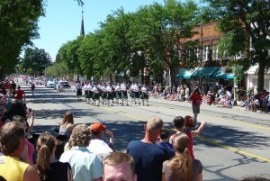
You don’t have to be Irish to celebrate. An old saying goes, “On St. Patrick’s Day, everyone is Irish.” There are parades and parties and festivals. In many homes, traditional Irish foods are made. Green is the color of the day. In some places, if you’re not wearing green, you can get pinched. In Chicago, green dye (harmless) is put into the river for that day. The fountain at the White House is made to be green.
Do you do anything special? Here are a couple of links where you can find LOTS of things to do.
http://familyfun.go.com/st-patricks-day/
http://www.enchantedlearning.com/crafts/stpatrick/

You don’t have to be Irish. The truth is, St. Patrick wasn’t Irish. He was Welsh. When it all started, his color wasn’t green, it was blue.
Let’s learn something about him, about Ireland, about shamrocks, and … well, about some things fun and silly, too.
History of St. Patrick
March 17 is St. Patrick’s Day. He is the patron saint of Ireland – even though he was Welsh (from Wales). His exact history is unknown. He lived somewhere between the years 340 and 500 A.D. (That’s about 1600 years ago.) Nobody knows exactly.
When he was about 16, raiders from Ireland came across the Irish Sea and into England, Scotland, Cornwall and Wales. They took Padrig (his Welsh name) captive. He became a slave. Among other things, he was to watch over the sheep in those green hills of Ireland. After about six years he escaped and went back to Wales.
There he joined the church, studied hard and became a bishop. Because he knew the people of Ireland, he was sent to teach them about Christianity. He probably didn’t want to go. These were the people who made him a slave. He went anyway. It was very difficult. Sometimes it was dangerous. He wasn’t going to give up, though. Just one of the ways he taught, the legend says, was to use the four-leaf clover as an example.
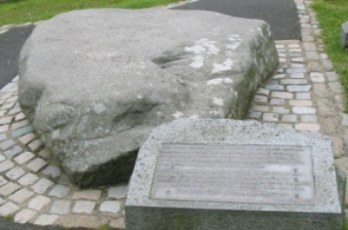

One legend says that he drove the snakes out of Ireland. Although this probably didn’t happen, the story can be fun. This legend says that St. Patrick planted shamrocks to keep the snakes out. It is said that shamrocks grow wherever he preached. (We’ll get back to that in a moment.)
It is said that he died on March 17, but nobody knows the year for sure. Later this became St. Patrick’s Day. It is still a religious holiday, but much like other holidays, it got bigger.
The Emerald Isle
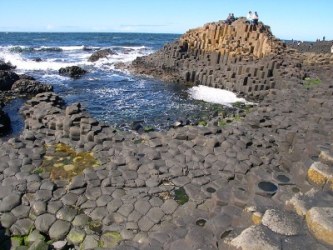

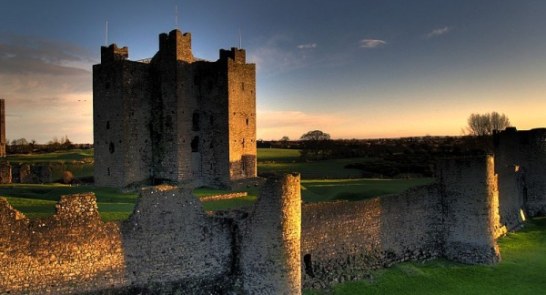


Ireland is an island country. It is separated from England, Wales and Scotland (the United Kingdom) by the Irish Sea. Most of it is called the Republic of Ireland. A small section is part of the United Kingdom and is called Northern Ireland.
The climate (weather) is pretty nice all year long. This makes lots of plants grow, and that makes much of the island very green. Because of this, it is called the Emerald Isle. (Emeralds are green.) That’s why green is used for many things Irish, such as St. Patrick’s Day.
If you like history, Ireland has lots of it. Look and you’ll find green hills and fields. You’ll find shorelines. You’ll find farms and villages and towns and cities. You’ll find castles, some 1000 years old. These show part of an amazing history.
Have you ever heard the name Celt? (It’s pronounced Kelt.) That’s who the people were in Ireland. Then Christian missionaries, such as St. Patrick, came. A few hundred years later, the Vikings began to invade. Eventually the English took over Ireland. That lasted a very long time.
About a hundred years ago, the island was being divided into two countries. The Republic of Ireland is the biggest part. They wanted to be free of England. A smaller part wanted to still be part of the United Kingdom. That’s now called Northern Ireland. More fighting continued until about 10 years ago.
The beauty of Ireland remains. So do traditions, and there are many. One is St. Patrick, and with that comes the color green – and the green shamrock.
Green Shamrocks
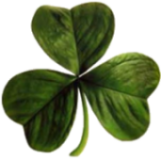
Long ago, St. Patrick was more associated with the color blue. This changed. As you know, Ireland is called The Emerald Isle because so much of it is green. One of the plants common there is the shamrock. This is a 3-leaved clover that St. Patrick was said to have used to teach about the Christian trinity.
The clover, or shamrock, usually has three leaves. A very old tradition says that the leaves are for faith, hope and love, with the rare fourth leaf being luck. St. Patrick is said to have called the leaves Father, Son and Holy Spirit. For him the fourth leaf was God’s Grace.
This brings us back to the legend of how St. Patrick chased the snakes out of Ireland, and then planted the shamrocks to keep the snakes from coming back. One tradition says that shamrocks grow wherever St. Patrick preached.

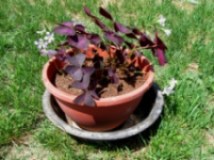
An old friend here is Paulie the Purple Plant From the Pampas of Peru. Click here to read his story. (You can also listen to the story, as read by Kathleen McCarthy.) Paulie is a purple shamrock. His real name is oxalis, but his friends call him Paulie.
LEPRECHAUN
The leprechaun is a kind of fairy. They are said to be small in size (probably smaller than you) but large in mischief. They are constantly playing tricks on people – some of them not very nice. They often wear coats of bright red, or bright green. There are two important parts of the legends.
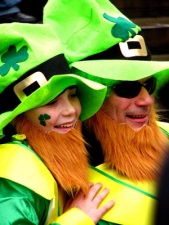

One is that they love gold. They love to get it, but hate to spend it. Often, it is collected in pots and then hidden. But there is a sort of treasure map. When it rains, a rainbow might appear. The end of that rainbow points to where the pot of gold is buried.
The other is that if a human captures a leprechaun, three wishes will be granted.
WHAT WILL YOU DO?
You don’t have to be Irish to have some fun for this day. Probably the simplest is to wear green. If you don’t have anything green, it’s easy to bend a green pipe cleaner into the shape of a shamrock. It can become a string or necklace. Here are just a few places where you can find ideas.
http://st-patrick.craftideas.info/
http://www.craftelf.com/craft_elf_holiday_St.%20Patrick%27s%20Day.htm
http://www.busybeekidscrafts.com/St-Patricks-Day-Crafts.htmlM
Of course, there are traditional Irish foods.
http://en.wikipedia.org/wiki/Irish_cuisine
http://www.whats4eats.com/europe/ireland-cuisine
IRISH STEW

There are so many ways to make this. All of them are based around chunks of lamb or mutton, chunks of potato and onion, and chopped parsley. with salt and pepper, then water. It all goes into a pot and is simmered for about 2 hours. From there, it changes from region to region, even from cook to cook. It’s common to add carrots. Some use parsnips. (This is sort of like a carrot but sweeter.) Rutebegas or turnips might be used. Among other things that can go into it are garlic, pearl barley, chopped leeks, butter, rosemary, bay leaves … the list goes on and on.
It came about as most stews have with the cook putting in pretty much whatever was available at the time. Raising sheep was common, so lamb or mutton was the meat used. The neck and shoulder was the usual meat, and often from older sheep (mutton). Potatoes were a staple, just as rice is a staple in parts of the Orient. Various root crops such as carrots, parsnips, rutabagas and turnips were available. Various herbs (parsley, bay leaves, rosemary) often grew wild.
Recipes like this can be confusing because they change depending on what you like, and have.
1-2 pounds of lamb or mutton, cubed
3-6 potatoes, washed, peeled or unpeeled, quartered
2-4 carrots, peeled, sliced
1-2 onions, sliced
Salt and pepper to taste
Optional
1-2 parsnips, peeled and sliced
1-2 turnips or rutabagas, cubed
1 bay leaf
Chopped parsley
Brown the meat, preferably with butter or olive oil. (This is an optional step. Some prefer to let the simmering cook the meat.) Add the other ingredients and pour in enough water to cover. Bring to a boil. Reduce heat to a simmer. Simmer for 1-2 hours until the meat is cooked and tender. Stir occasionally. Add more water if needed, but remember that this is a stew not a soup. Put in bowls and serve with chopped parsley as a garnish.
|
Like this story? |
