
Story Hour
To the Beat of a Drum
Written by Gene B. Williams
|
Click here for the archive page with a list of previous stories. Please remember that all materials on this website are copyrighted. No reproduction without express permission. |
Of course no one knows for sure, but likely the drum was the first musical instrument. All you need is something to hit, and something to hit it with. Drums are called percussion because the word percussion means “to hit.”
Have you ever thought about all the different ways this can be done? Here is a simple experiment you can do right now. Use your finger and tap it in a few places around you. Where I’m sitting right now I have quite a few things. I have three different tables, a filing cabinet, a printer, some books, a trash can … so MANY different things. And when I tap them, each has a different sound.
What do you have around you that you can tap?
How many different sounds can you make? And if you use something other than your finger, like a pencil, you can make still more sounds!
Most people use the word “drum” for something where there is a “skin” to hit. These aren’t the only drums. Usually they are round, but they can be any shape. That skin these days is usually a kind of plastic. It can also be leather, rubber or something else. This kind of drum may or may not have a second skin on the bottom. One kind, the snare drum, has springs that rattle when you beat the drum. Another kind, called a timpani, can be adjusted (tuned) to make different sounds. This kind often comes in a set of different sizes. Each makes its own sound.
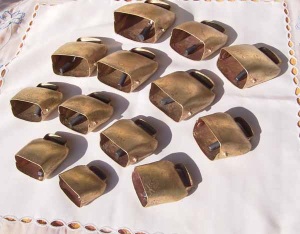
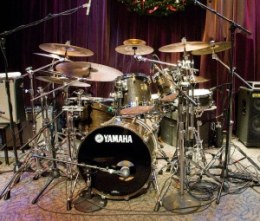
A drum set, or drum kit, has a number of drums, each different. There is usually a bass drum for the deeper sounds. That is usually played with a foot pedal. Stomp on the pedal and a cloth covered mallet hits the drum to make the low (but loud) sound. Placed around the drummer are other kinds of drums of different sizes to make different sounds. It usually includes things like cymbals, which are shaped pieces of metal, usually brass, to make the clanging sound. These also come in all kinds of sizes and types. Each makes its own sound. The drummer might also have other things to hit, like cow bells.
 |
 |
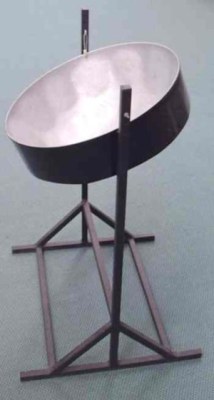
Steel Drum |
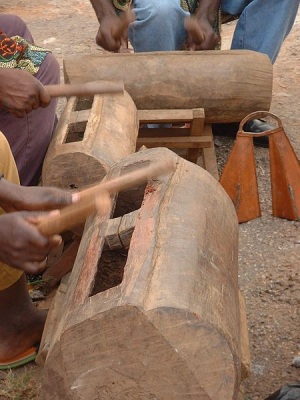
African Slit Drum |
 |
 |
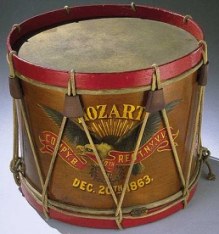
Civil War Drum |
Cowbells |
 |
 |
Energizer Drum |
Marching Drum |
 |
 |
Drum Set |
American Indian Drum |
 |
 |
Drum Sticks |
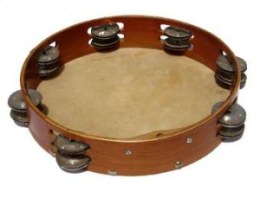
Tamborine |
A very special drum is the steel drum. It’s usually thought of as being part of the music from the islands in the Caribbean Sea. Often this starts with a steel trash barrel. It is carefully measured and cut the end cut off. The bottom is then hammered to make a bowl. Then very carefully “dents” are hammered into the steel. The size and shape of the dent will make a particular note. You can watch it being done here. Click on this and you will see people making and playing a steel drum.
http://www.youtube.com/watch?v=mQu5Unc_TNY
MAKE A DRUM
Oh, gosh, there are more ways to make a drum than you have time to make them. You can use a cereal box and a pencil. A round oatmeal box even looks like what most think of as a drum.
A tambourine is a kind of drum. It’s round and has jingles.
A xylophone is another kind of drum, if you think about it. You might even have one. Pieces of wood, metal or plastic of different lengths make different notes. It sounds a little like a piano, and it should because a piano has felt pads hitting strings of different lengths. In a way, a piano is like a very complicated drum.
Are you getting the idea? Almost anything can be a drum. It can be a pot from the kitchen, with the drumstick being a spoon. (Mom and Dad, and the neighbors, might like it better, though, if you use an old cereal box. It’s not as noisy.)
Here are just two ways.
Click here (http://www.wikihow.com/Make-a-Homemade-Drum) for a link to directions on how to make a drum from an oatmeal box and tape. They suggest electrical tape but any tape will do. (I would use duct tape.) It’s easy. Put the tape over the top of an empty oatmeal box – decorate however you wish – and have fun.
This is a video (http://www.youtube.com/watch?v=sOa_4ON8lxc ). An oatmeal box is used again, but this time a balloon is used. It’s much the same. Cut the narrow end off of the balloon, spread it over the empty oatmeal box, secure it with a rubber band. Done! Then decorate any way you wish.
Use your imagination. You’ll find all sorts of ways to make your own drums. Remember that they can be any size. These two were examples that used oatmeal boxes. You can use other cereal boxes, or tin cans or pop bottles. Mostly, use your imagination.
Don’t forget that kazoo. Captain Kazoo’s motto is “hum don’t blow.” For you we’ll make a new motto.
“Hum and Drum!”
DRUM CODE
No one knows how long drums have been used to send messages. The sound can carry a long distance. It’s easy to make high notes and low notes, and easy to make long notes and short notes.
A log can be carved to produce different sounds depending on where you hit it. Or you can make a drum bigger or smaller. You can even make a drum that can be tuned. All these sounds can travel across a distance. They can talk!
A different version, which is still the same, is Morse Code.
Do you know what “digital” means? It’s how this computer works. It’s on, or it’s off – a little like hitting the drum or not hitting it.
Thump thump tick.
That’s the letter G in Morse Code.
To spell Nicker is:
thump tick (N)
tick tick (I)
thump tick thump tick (C)
thump tick thump (K)
tick (E)
tick thump tick (R)
Try it. If someone else knows Morse Code, these tiny and simple sounds can be sent around the world, or farther, and they will know that you just spelled “Nicker.”

|
Like this story? |
